
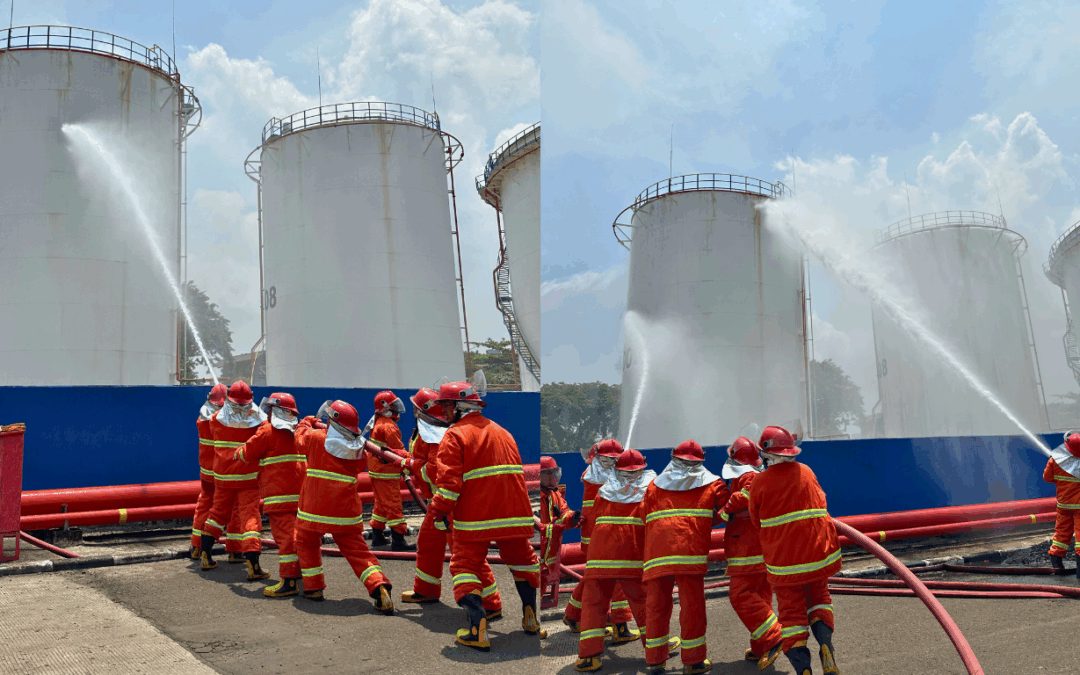
As part of our ongoing commitment to ensuring a safe and resilient working environment, Linc Terminal conducted its annual Fire Drill and Emergency Response Training at our storage tank. This yearly program is designed not only to comply with safety regulations but also to enhance the readiness, awareness, and coordination of our on-site personnel.
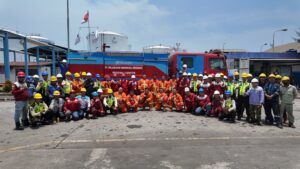
Because of the nature of our operations: handling liquid cargo, supporting vessel-to-tank transfers, maintaining storage tank facilities, and operating heavy equipment, the consequences of delayed response or inadequate preparation can be significant. This is why our team undergo rigorous drills that simulate real emergency conditions. The fire drill consisted of several key activities that mirror real emergency scenarios:
- Alarm activation and full personnel evacuation
- Activation of fire protection systems
- Simulation of leak or spill containment
Each activity played a crucial role in training our team to respond quickly, communicate effectively, and act with precision.
Alarm Activation & Personnel Evacuation
The training began with the activation of the emergency alarm system, a critical component designed to alert all personnel within the facility. Upon hearing the alarm, employees immediately followed the predetermined evacuation routes. This simulation aims to create familiarity and speed: during a real emergency, every second matters. The drill allows our team to practice calm, orderly evacuation, minimizing confusion and ensuring full coordination throughout the terminal. Proper evacuation procedures are particularly vital in a storage tank environment, where quick response helps reduce risks related to heat exposure, smoke movement, or potential escalation.
Activation of Fire Protection Systems
The next phase focused on the deployment of fire protection systems, including hydrants, hoses, and portable extinguishers. Our team demonstrated how to control and isolate fire points in critical areas. This exercise allowed employees to understand how the system works, where equipment is located, and how different units collaborate during a fire incident. By simulating real operational pressures, the team becomes more confident and capable of taking swift action should an actual emergency occur. The drill reinforces one core message: fire protection equipment is only effective when operators know how to use it, and use it fast.
Leak or Spill Containment Simulation
Given that Linc Terminal handles liquid cargo stored in tanks and pipelines, leak or spill scenarios are among the most important emergency situations to prepare for. To strengthen readiness, the team conducted a simulated containment procedure that mimicked an actual product spill. Using absorbent materials, barriers, and containment tools, the team worked together to isolate the affected area, prevent further spread, and mitigate potential environmental impact. This phase of the drill is essential for maintaining compliance with environmental safety standards and demonstrating our commitment to protecting the surrounding ecosystem.
Beyond the technical components, the fire drill serves an even greater purpose: cultivating a strong safety mindset. When every employee is familiar with the procedures, not only ERT and operators, but all on-site personnel, the terminal becomes a safer, more reliable environment for everyone.
The success of this year’s fire drill reflects the dedication of our teams and the strength of our safety-first culture. We extend our appreciation to all employees who participated with discipline, cooperation, and enthusiasm. At Linc, we believe that strong operations start with strong safety practices. Through continuous training, collaboration, and awareness, we ensure that our storage tank operates with the highest standards of safety and reliability.
Safety is everyone’s responsibility. Safety is our shared commitment.
Watch the video below to learn more about the fire drill that we did!